
The AI New Deal
Bradenkelley.com · View original source
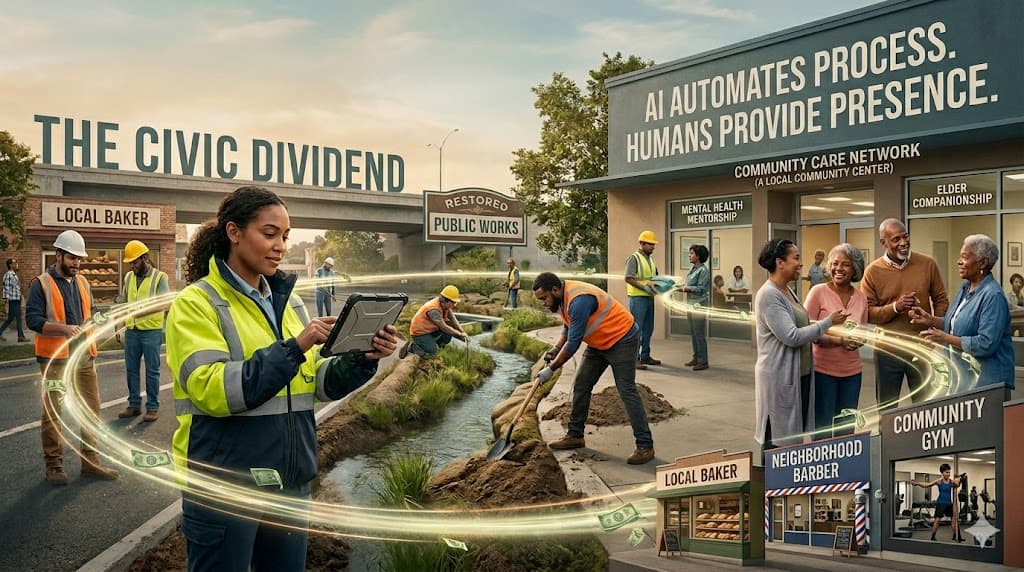
As the landscape of work continues to evolve under the influence of artificial intelligence (AI), the concept of an "AI New Deal" has emerged as a critical framework for addressing the displacement of cognitive and administrative labor. The conversation surrounding this framework highlights the urgent need for a proactive approach to economic stability and social cohesion in an increasingly automated world. The AI New Deal proposes a shift from traditional safety nets like Universal Basic Income (UBI) to a more dynamic model that emphasizes active contribution and community engagement.
The Flaws of Universal Basic Income
Universal Basic Income has often been heralded as a solution to the challenges posed by AI and automation. However, a closer examination reveals significant shortcomings in its design. While UBI provides a financial safety net, it does not inherently foster a sense of agency or contribution among individuals. The fundamental issue lies in the reliance on a shrinking tax base as AI technologies drive down labor costs, leading to a diminished pool of income tax revenue. This situation creates a precarious economic environment where passive redistribution may inadvertently lead to a "subsistence trap" for many individuals.
Moreover, the concept of agency is crucial for innovation and personal fulfillment. UBI, by decoupling income from productive contribution, risks creating a societal class that feels disconnected from meaningful work. This is particularly concerning in an era where human qualities—such as empathy, creativity, and nuanced judgment—are becoming increasingly valuable as AI takes over more routine tasks. Without a framework that encourages active participation, we may inadvertently foster a sense of worthlessness among those who are unable to find their place in an automated economy.
The Civic Dividend as a New Paradigm
In response to these challenges, the AI New Deal introduces the concept of a Civic Dividend, which positions the government as the "Employer of First Resort." This model seeks to ensure that citizens have access to meaningful employment opportunities in essential sectors such as infrastructure maintenance, community care, and cultural preservation. By focusing on roles that require uniquely human skills, the Civic Dividend aims to create a robust social fabric that is resilient to the disruptions caused by automation.
The Civic Dividend operates on the principle that human labor is a public asset. It proposes a proactive approach where the government identifies and funds work that is vital for the community's well-being. This includes not only traditional public works but also roles in elder care, mental health support, and community engagement. By investing in these areas, the Civic Dividend not only provides a living wage but also fosters a sense of dignity and purpose among workers.
This approach also addresses the issue of economic circulation. When individuals are employed in meaningful roles, their earnings are reinvested into the local economy, supporting businesses and services that rely on human interaction. This creates a cycle of economic activity that benefits the community as a whole, contrasting sharply with the passive nature of UBI payments that may not stimulate local economies effectively.
Implications for Creators and Technologists
The AI New Deal presents significant implications for creators and technologists as it redefines the relationship between technology and human labor. As AI continues to optimize various processes, the demand for human presence and creativity will only grow. This shift necessitates a reevaluation of how we perceive work and its value in society. Creators and technologists are uniquely positioned to contribute to this new paradigm by developing tools and platforms that facilitate human connection and community engagement.
Moreover, the focus on the "Un-automatable" aspects of work opens new avenues for innovation. As roles in care, culture, and community resilience gain prominence, creators can explore ways to enhance these sectors through technology. This could involve developing applications that support mental health, platforms for local artists, or tools that facilitate community-building initiatives. By aligning technological advancements with the principles of the AI New Deal, creators can play a pivotal role in shaping a future that values human contribution over mere efficiency.
In conclusion, the AI New Deal offers a transformative vision for navigating the challenges posed by automation and AI. By shifting the focus from passive income support to active engagement in meaningful work, it lays the groundwork for a more resilient and connected society. As we stand at this crossroads, the choices we make today will determine the future of work and community in an increasingly automated world. The tools for this transformation are within our reach, and it is imperative that we seize the opportunity to design a future that prioritizes human dignity, agency, and contribution over mere survival.
Frequently asked questions
- What is the AI New Deal?
- The AI New Deal is a proposed economic framework that emphasizes active contribution and community engagement in response to the challenges posed by artificial intelligence and automation.
- How does the Civic Dividend differ from Universal Basic Income?
- The Civic Dividend focuses on providing living wages for meaningful work, while Universal Basic Income offers passive payments regardless of individual contribution.
- What sectors does the AI New Deal aim to support?
- The AI New Deal aims to support sectors that require uniquely human skills, such as infrastructure maintenance, community care, and cultural preservation.
Related stories
AI & art news in your inbox, daily
The day's top stories, summarized. Free, no spam, unsubscribe anytime.