
Nvidia introduces BlueField-4 STX reference architecture for AI storage systems
SiliconANGLE News · View original source
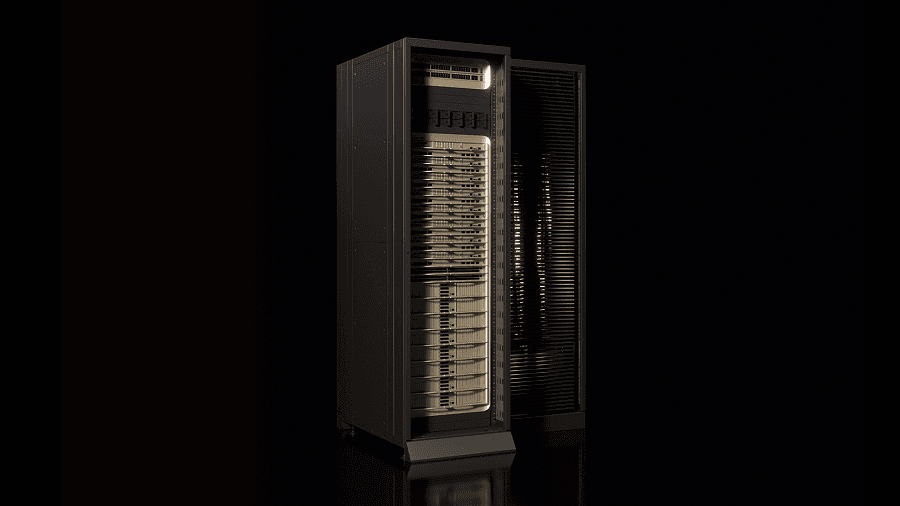
Nvidia Corp. has unveiled a groundbreaking reference architecture known as BlueField-4 STX, designed specifically for the development of storage equipment tailored for artificial intelligence (AI) clusters. This announcement was made during the company’s GTC developer event, highlighting Nvidia's commitment to advancing AI infrastructure.
Nvidia's Chief Executive Officer, Jensen Huang, emphasized the necessity for a new class of storage solutions to support AI systems that require extensive context and continuous learning. He stated, “NVIDIA STX reinvents the storage stack, providing a modular foundation for AI-native infrastructure that keeps AI factories operating at peak performance.” This assertion underscores the evolving demands of AI applications, which necessitate innovative storage solutions to maintain optimal performance.
At the core of the BlueField-4 STX architecture is the BlueField-4 data processing unit (DPU), which Nvidia first introduced in January. The DPU plays a critical role by offloading various infrastructure management tasks from a server's primary processor. This offloading process frees up computing resources for applications, enhancing overall efficiency. Specifically, the BlueField-4 DPU is responsible for managing data traffic between graphics processing units (GPUs) and flash storage, a vital function in AI workloads.
In addition to the DPU, the BlueField-4 STX architecture incorporates Nvidia's Spectrum-X Ethernet switches and ConnectX-9 SuperNICs. These components facilitate a technology known as Remote Direct Memory Access (RDMA), which allows data to bypass the server's central processing unit and operating system. This capability significantly accelerates data traffic flow, addressing one of the critical bottlenecks in traditional storage systems.
Nvidia claims that the BlueField-4 STX architecture can process tokens—fundamental units of data utilized by AI models—up to five times faster than previous storage architectures. Furthermore, the company anticipates a fourfold improvement in energy efficiency, a crucial consideration as the demand for AI processing power continues to escalate.
The first implementation of the BlueField-4 STX architecture is a storage system design called CMX, specifically optimized for managing key-value caches. These caches are essential data structures employed by large language models (LLMs) to store and retrieve information efficiently. LLMs utilize an attention mechanism to analyze prompts, identifying and prioritizing the most relevant elements. This process involves transforming prompt contents into mathematical representations known as vectors, which include keys for information retrieval and values that store the information itself.
The CMX system is designed to store an AI cluster’s key-value cache in high-speed flash storage, leveraging BlueField-4 chips to offload crucial data management tasks from the host cluster's CPUs. This offloading is expected to enhance performance significantly, allowing for more efficient processing of AI workloads.
Moreover, CMX offers additional performance improvements by circumventing the need for hardware-intensive algorithms typically used to mitigate data loss risks. Since key-value caches do not require the same level of data loss protection as standard business records, CMX can avoid the associated hardware overhead. The transient nature of the information in a key-value cache, which is often easy to recover and retained for a limited duration, supports this streamlined approach.
Looking ahead, Nvidia anticipates that partners will begin shipping BlueField-4 STX systems in the latter half of 2026. The company has already garnered interest from over half a dozen customers, including notable early adopters such as Oracle Corp., Mistral AI SAS, and CoreWeave Inc. This early engagement indicates a strong market interest in the innovative capabilities of the BlueField-4 STX architecture and its potential to reshape AI storage solutions.
As the landscape of AI technology continues to evolve, the introduction of Nvidia's BlueField-4 STX architecture marks a significant step forward in addressing the unique storage needs of AI applications. By enhancing data processing speeds and energy efficiency, this architecture promises to empower creators and technologists to push the boundaries of what AI can achieve.
Why it matters
The launch of the BlueField-4 STX architecture by Nvidia is a pivotal development for creators and technologists working in the AI space. As AI systems become increasingly complex and data-intensive, the demand for advanced storage solutions will only grow. The ability to process data at unprecedented speeds while improving energy efficiency is crucial for organizations looking to harness the full potential of AI technologies.
Moreover, the modular nature of the BlueField-4 STX architecture allows hardware manufacturers to build customized solutions that cater to specific AI workloads. This flexibility can lead to a more diverse range of applications and innovations in the AI field, as different sectors explore how best to leverage these advancements.
Additionally, the early adoption by major companies indicates a strong belief in the potential of this technology to transform AI infrastructure. As more organizations begin to implement BlueField-4 STX systems, it could set a new standard for how AI storage solutions are designed and utilized, ultimately influencing the future trajectory of AI development and deployment.
Frequently asked questions
- What is the BlueField-4 STX architecture?
- The BlueField-4 STX is a reference architecture introduced by Nvidia for building storage systems tailored for artificial intelligence clusters.
- How does the BlueField-4 DPU improve performance?
- The BlueField-4 DPU offloads infrastructure management tasks from a server's main processor, freeing up computing capacity for applications and enhancing overall efficiency.
- What types of companies are adopting the BlueField-4 STX architecture?
- Early adopters include major companies like Oracle Corp., Mistral AI SAS, and CoreWeave Inc., with plans to implement the technology in the second half of 2026.
Related stories
AI & art news in your inbox, daily
The day's top stories, summarized. Free, no spam, unsubscribe anytime.