
From Screen To World: 5 Ways To Use AI To Spark Hands-On Learning In K–12 Classrooms
Teachthought.com · View original source
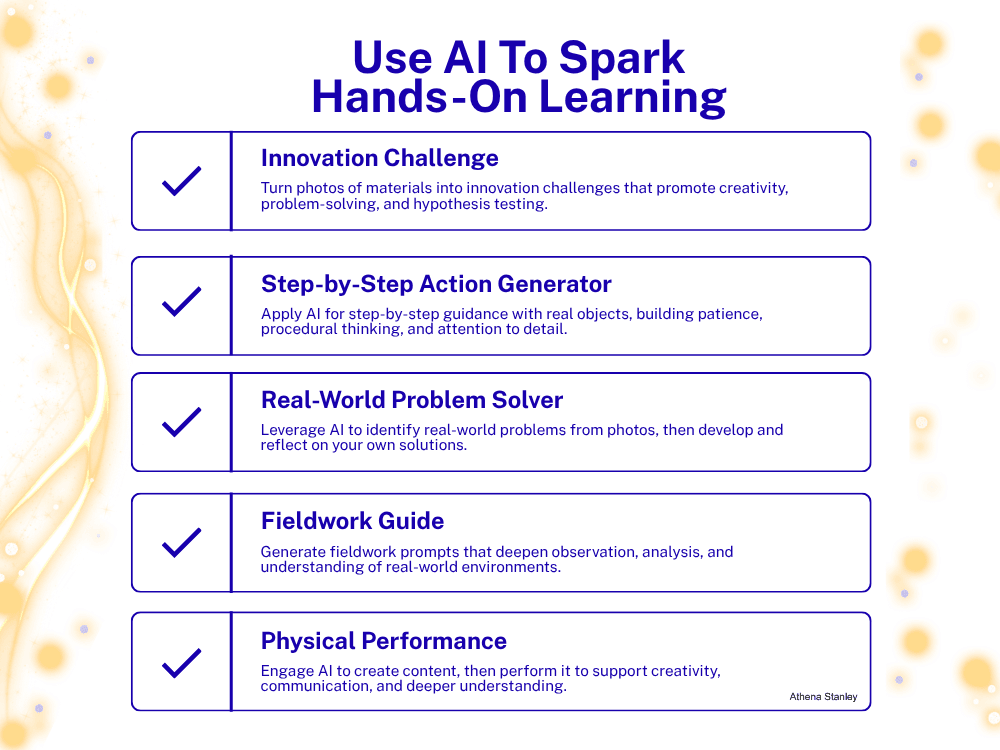
Artificial Intelligence (AI) is increasingly recognized as a transformative tool in education, particularly in K–12 classrooms. When effectively integrated with strong ethical foundations—such as integrity, data privacy, bias awareness, and misinformation detection—AI can enhance student learning experiences. However, many educators express caution regarding the potential downsides of AI, including overreliance on technology, diminished critical thinking skills, academic dishonesty, and excessive screen time. These concerns are significant and merit careful consideration.
The crux of the matter lies in the understanding that AI's true potential is not realized when students remain glued to screens. Instead, it is most effective when it serves as a catalyst for real-world engagement, encouraging students to think critically, create, and take action beyond digital confines. The objective is not merely to have students use AI but to leverage it as a means to propel them into hands-on learning experiences.
Practical Strategies for Hands-On Learning
To facilitate this transition from screen to world, educators can implement five practical, classroom-ready strategies that utilize AI as a springboard for off-screen learning. These strategies can be tailored to fit the specific context, grade level, and educational goals of each classroom.
One approach involves providing students with a collection of physical materials for exploration, either individually or in groups. After taking a photo of these materials, students can prompt AI to generate an innovation challenge based on their observations. This method fosters creativity, problem-solving, and experimentation. For instance, a prompt might read: "I am a [grade] student. I will upload a photo of materials I have. Based on these materials, create an innovation challenge for me that includes forming a hypothesis, testing ideas, or presenting a final solution from the perspective of an inventor."
Another strategy is to guide students through task completion using AI-generated, step-by-step instructions. By taking a photo of an object, students can request AI to provide instructions for a specific task, ensuring that they complete each step physically before moving on to the next. This method not only builds procedural thinking but also enhances patience and attention to detail. A sample prompt could be: "I will upload a photo of an object. Give me step-by-step instructions to complete a task using this object. Only give me one step at a time. After each step, I will confirm I completed it (and send a photo of my progress) before you give the next one."
Additionally, students can take photos of their surroundings—be it at school, home, or in the community—and ask AI to identify potential problems in those settings, without providing solutions. This encourages independent or collaborative problem-solving as students work to devise their own solutions. They can later compare their ideas with AI-generated feedback, which fosters evaluation and reflection. A suitable prompt might be: "Ask me 2–3 follow-up questions to help me think more deeply about the problems."
During fieldwork or observation activities, AI can assist in generating prompts that enhance students' noticing and analysis skills. These prompts can focus on various aspects such as systems, space, function, safety, cause and effect, and perspective, leading to richer observational data and deeper engagement with real-world environments. An example prompt could be: "I am going into a real-world environment for observation. Generate a fieldwork guide with observation prompts that include categories such as:"
Lastly, students can utilize AI to design performance-based representations of their learning, transitioning their work off-screen. AI can aid in creating songs, raps, scripts, or role-play scenarios that encapsulate academic content. This not only promotes creativity and communication skills but also allows for a deeper understanding through expressive performance. For example, a student studying mammals might generate a rap that explains key characteristics and habitats, which they can then refine and perform for their peers. A prompt could be: "Create a short [rap/song/script/role-play] that teaches the key ideas in a way I can perform. Include clear main ideas, but leave room for me to add my own words and actions."
Why it matters
The overarching theme in these strategies is that AI should serve to extend learning rather than confine it. When utilized thoughtfully, AI can create pathways for students to engage more profoundly with their surroundings. Importantly, the role of the teacher remains central in designing these experiences, shaping how AI is employed to initiate and guide learning. The ultimate goal is not merely the use of a tool but the cultivation of critical thinking and creativity among students.
In summary, the most impactful integration of AI in education may not be found in the activities conducted on screens but rather in the meaningful experiences that unfold once students step away from them. By harnessing AI to spark hands-on learning, educators can foster a generation of learners who are not only technologically savvy but also capable of thoughtful engagement with the world around them.
Frequently asked questions
- How can AI be used to enhance learning in K–12 classrooms?
- AI can be used to create innovation challenges, provide step-by-step task instructions, identify problems in real-world settings, generate observation prompts, and assist in designing performance-based learning activities.
- What are the concerns educators have about using AI in education?
- Educators are concerned about overreliance on technology, reduced critical thinking skills, academic dishonesty, and increased screen time.
- What is the role of the teacher when using AI in the classroom?
- The teacher's role is to design learning experiences that effectively integrate AI, guiding how it is used to initiate and support student learning.
Related stories
AI & art news in your inbox, daily
The day's top stories, summarized. Free, no spam, unsubscribe anytime.