
Elon Musk announces ambitious $20B Terafab project to manufacture chips for space-based AI
SiliconANGLE News · View original source
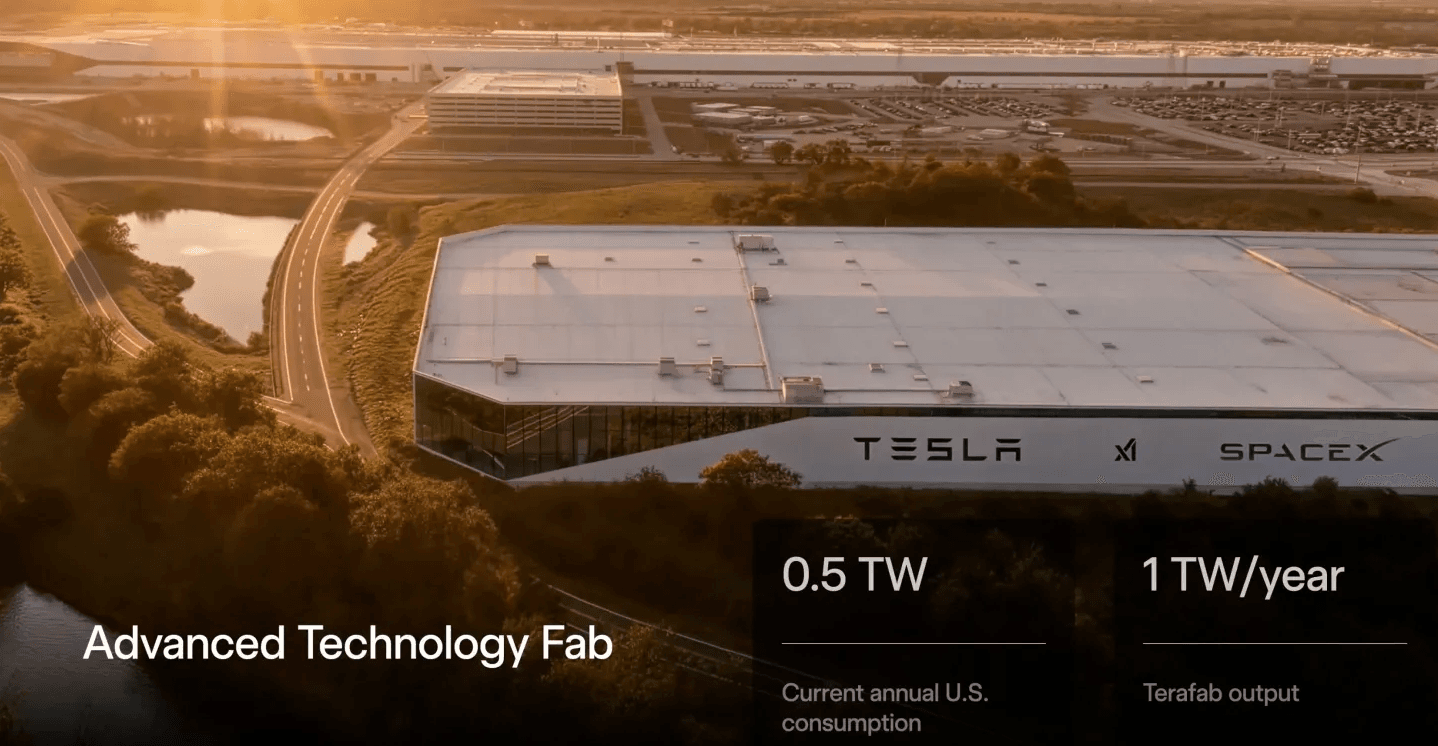
Elon Musk, the billionaire entrepreneur known for his ambitious ventures, has announced a groundbreaking initiative that aims to revolutionize the semiconductor industry. His companies, including Tesla Inc., SpaceX Corp., and xAI Corp., are collaborating on a new chip fabrication plant named "Terafab," which is projected to cost between $20 billion and $25 billion. This facility will be located at Gigafactory Texas in Travis County, near Austin, and aims to manufacture up to 1 terawatt of computing power annually, making it the largest semiconductor fabrication plant ever constructed.
The unveiling of Terafab took place at a special event held at the defunct Seaholm Power Plant in Austin, where Musk described the project as “the most epic chip building exercise in history by far.” This ambitious venture will consolidate every stage of the semiconductor manufacturing process under one roof, encompassing chip design, lithography, fabrication, memory production, advanced packaging, and testing.
At the heart of Terafab’s operations will be the production of two-nanometer chips, which represent the most advanced technology currently in commercial production. Presently, only Taiwan Semiconductor Manufacturing Co. (TSMC) has the capability to produce these chips, having invested decades and hundreds of billions of dollars to achieve this level of technological advancement. Musk's Terafab aims to challenge this dominance by setting staggering production targets, starting with 100,000 wafers per month and potentially scaling up to 1 million wafers per month when fully operational. This ambitious output would account for approximately 70% of TSMC’s current global production, all from a facility operated by companies that have no prior experience in chip fabrication.
The Vision for Terafab
Musk has outlined a bold vision for the chips produced at Terafab, which are expected to power various applications, including Tesla’s self-driving vehicles, Cybercab robotaxis, the Optimus humanoid robots, and data centers for xAI’s Grok. He emphasized the need for a massive supply of chips to realize his dream of a future populated by billions of robots and to facilitate interplanetary travel. Musk stated, “We want to be a civilization that expands to the galaxy with spaceships, that anyone can go anywhere they want at any time.” He believes that to achieve this vision, his companies will require “more chips than all the chip manufacturers in the world combined can provide today.”
Initially, Terafab will focus on producing two types of chips: inference chips for Tesla’s vehicles and robots, and D3 chips designed specifically for powering orbital AI satellites. Musk is particularly eager to accelerate the production of the next-generation A15 inference chips, which are expected to enter volume production by 2027, alongside the A16 chips that are currently in development.
Challenges and Implications
The Terafab project is not without its challenges. Analysts, including Holger Mueller from Constellation Research, have noted that the scale and ambition of the project rival some of Musk's most audacious undertakings. Despite the hurdles, Mueller believes that Musk's track record of achieving seemingly impossible goals positions him uniquely to succeed in this venture. He noted that Musk has previously launched xAI in July 2023 and rapidly developed its foundational model, Grok, to compete with established players like OpenAI.
The implications of a successful Terafab project could be significant for the semiconductor industry. Major chip manufacturers such as Nvidia, AMD, Intel, and Qualcomm will likely be closely monitoring Musk’s progress, as success could disrupt the current market dynamics. If Musk can deliver on his ambitious production goals, it may not only threaten existing chipmakers by reducing their customer base but also inspire other tech giants to pursue similar vertical integration strategies.
Furthermore, the U.S. government may view the success of Terafab favorably, as it aligns with efforts to boost domestic semiconductor manufacturing, a priority emphasized during the Trump administration. However, a key question remains: will Musk limit Terafab's output to his own companies, or will he open the facility to external clients?
Musk has indicated that he envisions 80% of Terafab's production capacity dedicated to developing chips for orbital AI satellites, with only 20% allocated for terrestrial applications. He argues that the advantages of solar irradiance in space and the potential for thermal scaling could make space-based data centers more cost-effective than their Earth-bound counterparts within a few years.
While the timeline for the Terafab project remains unclear, and no specific date has been provided for when production will commence, the announcement has undoubtedly set the stage for a new chapter in the semiconductor industry, driven by Musk's vision of a technologically advanced future.
Frequently asked questions
- What is the Terafab project?
- The Terafab project is a collaboration between Elon Musk's companies to build a semiconductor fabrication plant that aims to produce up to 1 terawatt of computing power annually.
- What types of chips will Terafab produce?
- Terafab will initially produce inference chips for Tesla vehicles and robots, as well as D3 chips designed for orbital AI satellites.
- How does Terafab's production capacity compare to TSMC?
- When fully operational, Terafab aims to produce 1 million wafers per month, which would account for approximately 70% of TSMC's current global output.
Related stories
AI & art news in your inbox, daily
The day's top stories, summarized. Free, no spam, unsubscribe anytime.