
Did Nvidia’s Jensen Huang just make the AI buildout too big to fail?
SiliconANGLE News · View original source
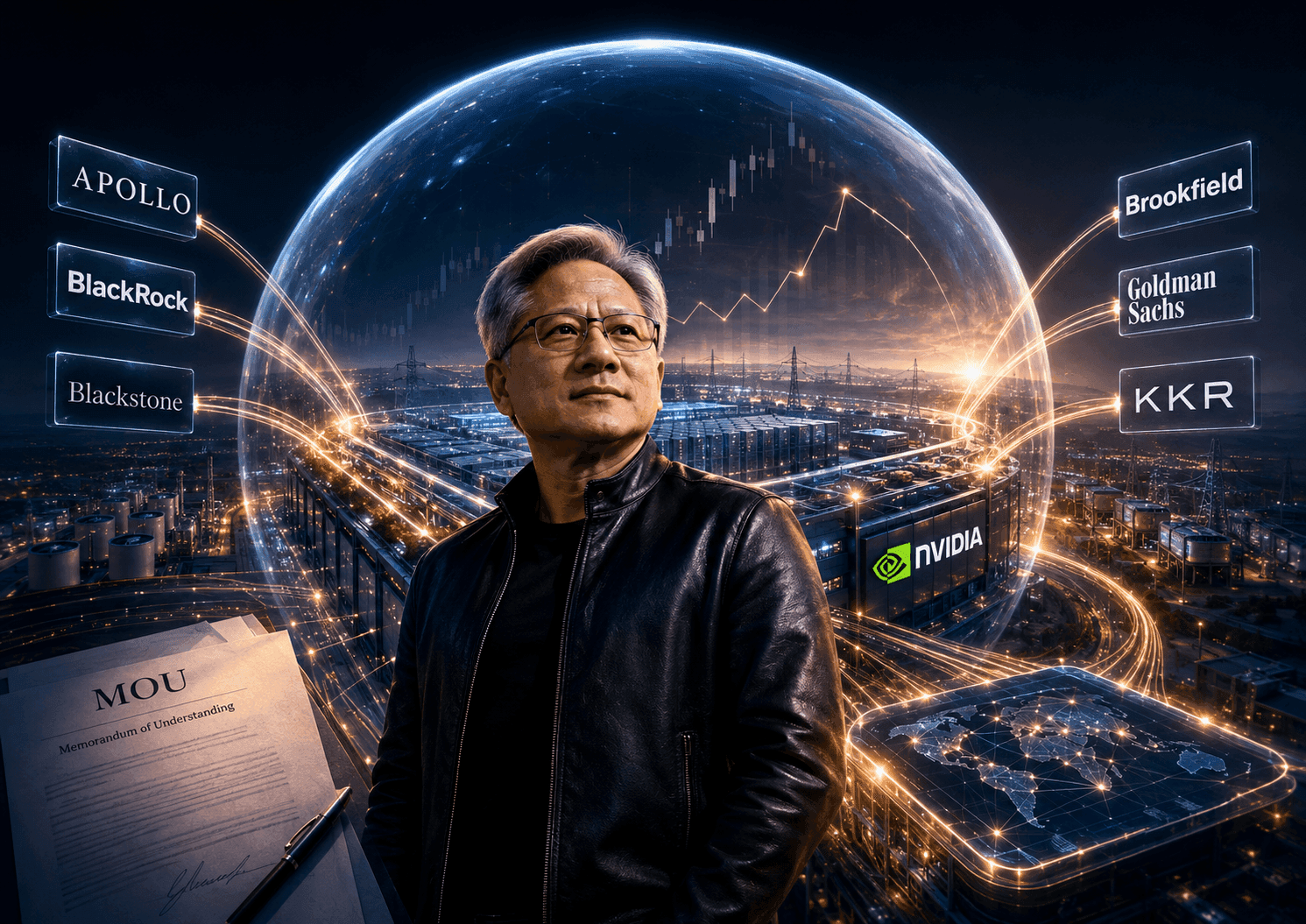
Nvidia Corp. is redefining its role in the technology landscape by not only selling hardware but also actively participating in the creation of a financial asset class centered around artificial intelligence (AI) compute. This strategic pivot was recently highlighted by Nvidia's Chief Executive Jensen Huang, who has initiated partnerships with major financial institutions, including Apollo, BlackRock, Blackstone, Brookfield, Goldman Sachs, and KKR. The objective of these collaborations is to establish financing platforms aimed at mobilizing over $500 billion for AI infrastructure. While this figure is impressive, it is crucial to note that this is not a currently funded pool but rather a goal that hinges on the completion of final agreements.
The ambition behind Nvidia's initiative is clear: to transform AI compute into collateral and position the AI factory as a financeable infrastructure asset. This development signifies that the narrative surrounding AI is evolving beyond a mere focus on chip technology. If the memorandum of understanding progresses into binding agreements, it could create a complex web of connections involving credit, leverage, customer contracts, monetization, cash flow, and the residual value of aging silicon. Such an interconnected system implies that a failure in one area could have broader implications, raising the question of whether Nvidia has made the AI buildout too big to fail.
Understanding Compute-Backed Credit
To grasp the implications of Nvidia's announcement, it is essential to understand how compute-backed credit functions. Currently, many AI factories are financed on a project-by-project basis, relying on a mix of corporate debt, customer prepayments, asset-backed loans, equity, and vendor financing. Nvidia's vision is to create a more standardized and repeatable financing process that allows institutional capital to flow into AI factories, underwriting them against customer commitments, utilization rates, cash flow, and the expected residual value of the installed compute.
This shift could potentially lower the cost of capital and expand access to AI infrastructure. However, it is important to recognize that while this model redistributes risk, it does not eliminate it. Nvidia aims for its systems to be viewed as more than just technology; they should serve as collateral, making AI infrastructure an attractive asset class for investors. The transition from individual company financing to institutional investment in AI infrastructure could fundamentally reshape how AI projects are funded.
The Role of Offtake Contracts and Risk Assessment
Central to this financing model are offtake contracts, which outline the obligations of customers to pay for the services provided by the AI factories. Lenders will scrutinize these agreements closely, seeking clarity on the payment obligations, contract duration, cancellation clauses, and the potential for revenue generation. As the AI factory becomes operational, the revenue generated must cover various costs, including power, cooling, maintenance, and debt service, while also providing returns to equity investors.
A critical aspect of this arrangement is the residual value of the compute systems after the initial customer contract concludes. Nvidia emphasizes that its systems are designed to be fungible and transferable, which is intended to enhance their economic lifespan and reassure lenders regarding their ongoing value. This is crucial for attracting investment, as lenders need to be confident that the AI factory can generate predictable cash flow and retain sufficient recovery value.
Nvidia's announcement also included a provision that allows the company to backstop up to $125 billion, or 25%, of the proposed $500 billion AI infrastructure financing initiative. This backstop raises important questions about the confidence of lenders and the perceived risks associated with the financing model. While some media interpretations suggest a negative connotation to this backstop, it is essential to understand that it is at Nvidia's discretion. If the financial landscape appears too risky, Nvidia can choose to absorb a portion of that risk, but it also has the option to walk away if it deems the project unviable.
Implications for Creators and Technologists
The implications of Nvidia's strategic move are significant for both creators and technologists in the AI space. By establishing a framework for financing AI infrastructure, Nvidia is not only facilitating the growth of AI capabilities but also potentially reshaping the economic landscape surrounding AI development. This could lead to increased investment in AI projects, allowing for more innovative applications and advancements in the field.
However, the interconnected nature of this financing model also introduces new risks. As AI factories become reliant on a network of financial agreements, any disruption in demand or pricing could have cascading effects throughout the ecosystem. Creators and technologists must remain vigilant about these dynamics as they navigate the evolving landscape of AI development.
In conclusion, Nvidia's efforts to create a financial asset class around AI compute represent a bold and transformative step in the technology sector. While the potential benefits are substantial, the associated risks and complexities warrant careful consideration as the market for AI infrastructure continues to evolve.
Frequently asked questions
- What is Nvidia's recent initiative regarding AI infrastructure?
- Nvidia has partnered with several major financial institutions to create financing platforms aimed at mobilizing over $500 billion for AI infrastructure.
- How does compute-backed credit work?
- Compute-backed credit involves financing AI factories against customer commitments and cash flow, allowing institutional capital to support AI infrastructure projects.
- What are offtake contracts and why are they important?
- Offtake contracts are agreements that outline customer payment obligations for AI factory services, and they are crucial for lenders to assess the financial viability of the projects.
Related stories
AI & art news in your inbox, daily
The day's top stories, summarized. Free, no spam, unsubscribe anytime.