
China’s AI Blitz Creates ‘Death Zone’ for Rival US Model Makers
Financial Post · View original source
In a significant turn of events, China's artificial intelligence sector is experiencing a surge of model launches that are rapidly closing the gap with Silicon Valley. This wave of innovation has created what some analysts are calling a 'death zone' for competitors lacking cutting-edge technology or disruptive pricing strategies. With major players like Alibaba, Moonshot AI, and ByteDance unveiling advanced models, the competitive landscape in AI is shifting dramatically, raising questions about the effectiveness of U.S. efforts to maintain its technological dominance.
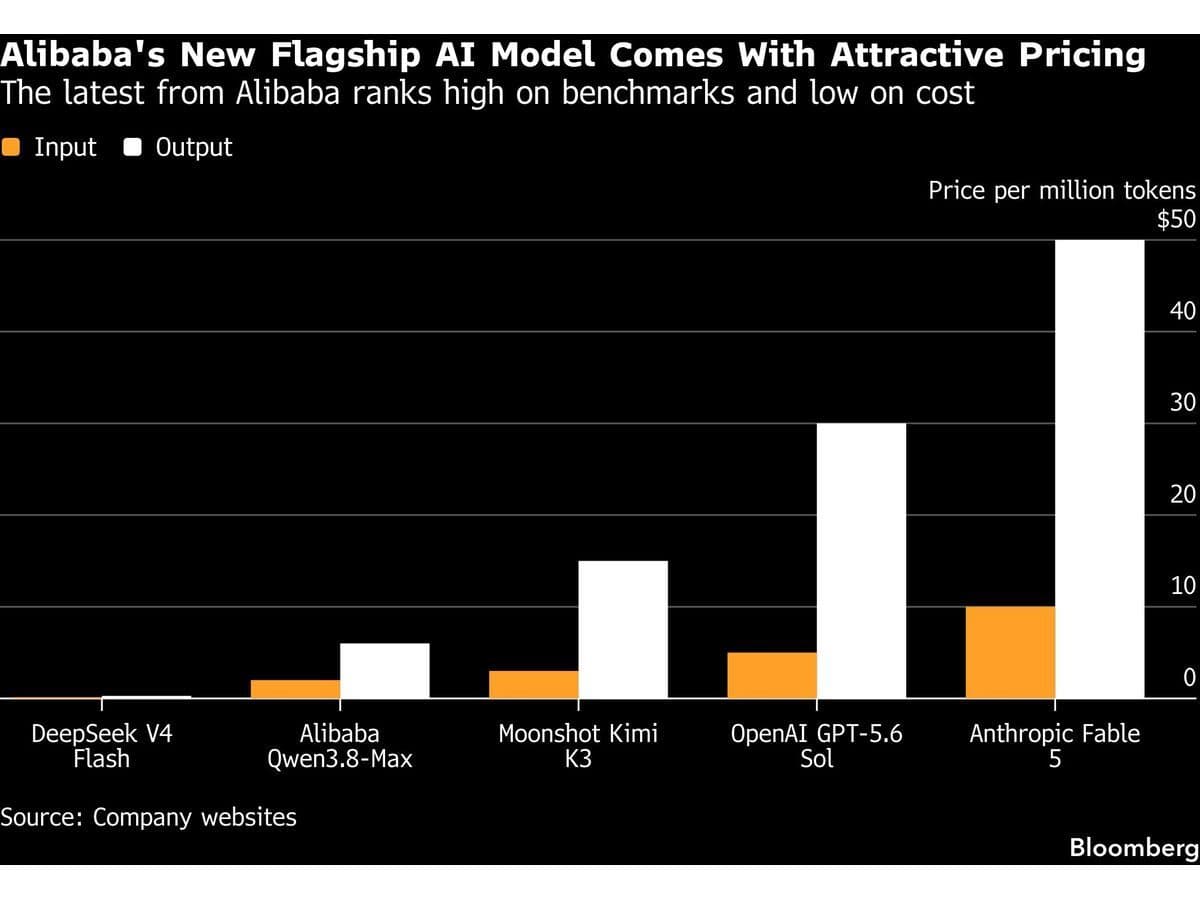
Alibaba Group Holding Ltd. has recently introduced its latest model, Qwen3.8-Max, which is touted as the company's most advanced offering to date. This new model appears to match or even exceed the capabilities of Anthropic PBC's flagship model, Fable 5. Just two weeks prior, Moonshot AI launched its Kimi K3, a model that demonstrated performance on par with some of the most expensive options available in the United States, despite being developed on a significantly lower budget. This development has ignited fresh concerns regarding the impact of U.S. chip sanctions aimed at curbing China's technological advancements.
In addition to these developments, ByteDance has solidified its position as a leader in video generation with the release of Seedance, version 2.5. Meanwhile, DeepSeek, a company recognized for its role in challenging U.S. dominance in AI, returned with its V4 Flash model, which represents a breakthrough in terms of affordability. The momentum generated by these releases signifies a shift from isolated advancements to a broader, more sustained wave of innovation, offering not only cost-effective alternatives but also high-end capabilities in reasoning, coding, and complex task execution. This evolution presents a formidable challenge to U.S. companies such as OpenAI and others that have long been viewed as the frontrunners in the AI space.
According to Poe Zhao, a tech analyst based in Beijing and founder of the Hello China Tech newsletter, the landscape has fundamentally changed since January 2025. Zhao notes, "The most important change since January 2025 is that China’s progress no longer looks like a single-company breakthrough." The initial impact of DeepSeek's innovations was significant, but the recent influx of models suggests that China has developed a reliable system for producing AI models that are competitive on a global scale. This rapid succession of five new models within eight weeks, including Z.ai's GLM-5.2, which was the highest-ranked open-source model globally at the time, indicates that Chinese developers are not only catching up but, in some instances, surpassing their U.S. counterparts.
One of the key factors contributing to this shift is the radical efficiency demonstrated by these Chinese models. In benchmark testing conducted by the independent evaluator Artificial Analysis, the cost of executing a complex real-world workload with DeepSeek's V4 Flash was just US$0.03, compared to US$3.15 for Anthropic's Claude Fable 5. This stark contrast in pricing illustrates how the competition for AI customers, particularly in markets outside the U.S. and China, is evolving. As China offers solutions at a fraction of the cost of American models, the dynamics of the global AI market are poised for significant change.
George Chen, a partner and Digital Practice chair at The Asia Group, highlights the cautious stance many countries are taking amid this competition. "A lot of countries are looking at the competition between U.S. and China, and they don’t want to take a side right now because the competition’s just starting," Chen explains. Both former President Donald Trump and Chinese President Xi Jinping have prioritized AI leadership as a national goal. Chen anticipates that Xi's upcoming visit to the White House in September will be influenced by the recent successes of companies like Kimi and Alibaba, providing Xi with leverage in discussions with Trump.
The rapid advancements in China's AI capabilities are intensifying the existing technological friction between the U.S. and China. In response to Moonshot's Kimi breakthrough, Washington has threatened sanctions over potential intellectual property violations. Trump has indicated that his administration is weighing the implications of China's advancements against the necessity for enhanced safety controls on products such as Anthropic's Fable and OpenAI's GPT series. "We have to be careful in both ways," Trump remarked to reporters in the Oval Office last Wednesday. "We don’t want to restrict them where all of a sudden, we come in second to China." This balancing act underscores the complexities of the U.S.-China tech rivalry as both nations strive for supremacy in the rapidly evolving field of artificial intelligence.
Why it matters
The rapid advancements in China's AI sector have profound implications for creators and technologists worldwide. As Chinese companies continue to produce high-quality AI models at lower costs, they not only challenge established U.S. firms but also redefine the competitive landscape in AI development. This shift could lead to increased innovation as companies are compelled to enhance their offerings to remain competitive.
Moreover, the growing capabilities of Chinese AI models may influence global market dynamics, particularly in regions that are currently undecided about which technological superpower to align with. As countries weigh their options, the competition between the U.S. and China may drive further investment and development in AI, ultimately benefiting creators and technologists who are able to leverage these advancements.
The ongoing U.S.-China tech rivalry also raises important questions about intellectual property rights and the future of innovation. As both nations navigate these challenges, the outcomes will likely shape the trajectory of AI development and its applications across various industries. Understanding these dynamics is crucial for creators and technologists looking to harness the potential of AI in their work.
Frequently asked questions
- What recent developments have occurred in China's AI sector?
- China's AI sector has seen a surge of model launches, including Alibaba's Qwen3.8-Max and Moonshot AI's Kimi K3, which are rapidly closing the gap with U.S. technology.
- How do the costs of Chinese AI models compare to U.S. models?
- Benchmark testing shows that executing complex workloads with Chinese models like DeepSeek's V4 Flash costs significantly less than with U.S. models, highlighting a competitive pricing advantage.
- What impact might the U.S.-China tech rivalry have on global AI development?
- The rivalry may influence global market dynamics, as countries weigh their options between U.S. and Chinese technology, potentially driving further investment and innovation in AI.
Related stories
AI & art news in your inbox, daily
The day's top stories, summarized. Free, no spam, unsubscribe anytime.