
A new type of electrically driven artificial muscle fiber
Mit.edu · View original source
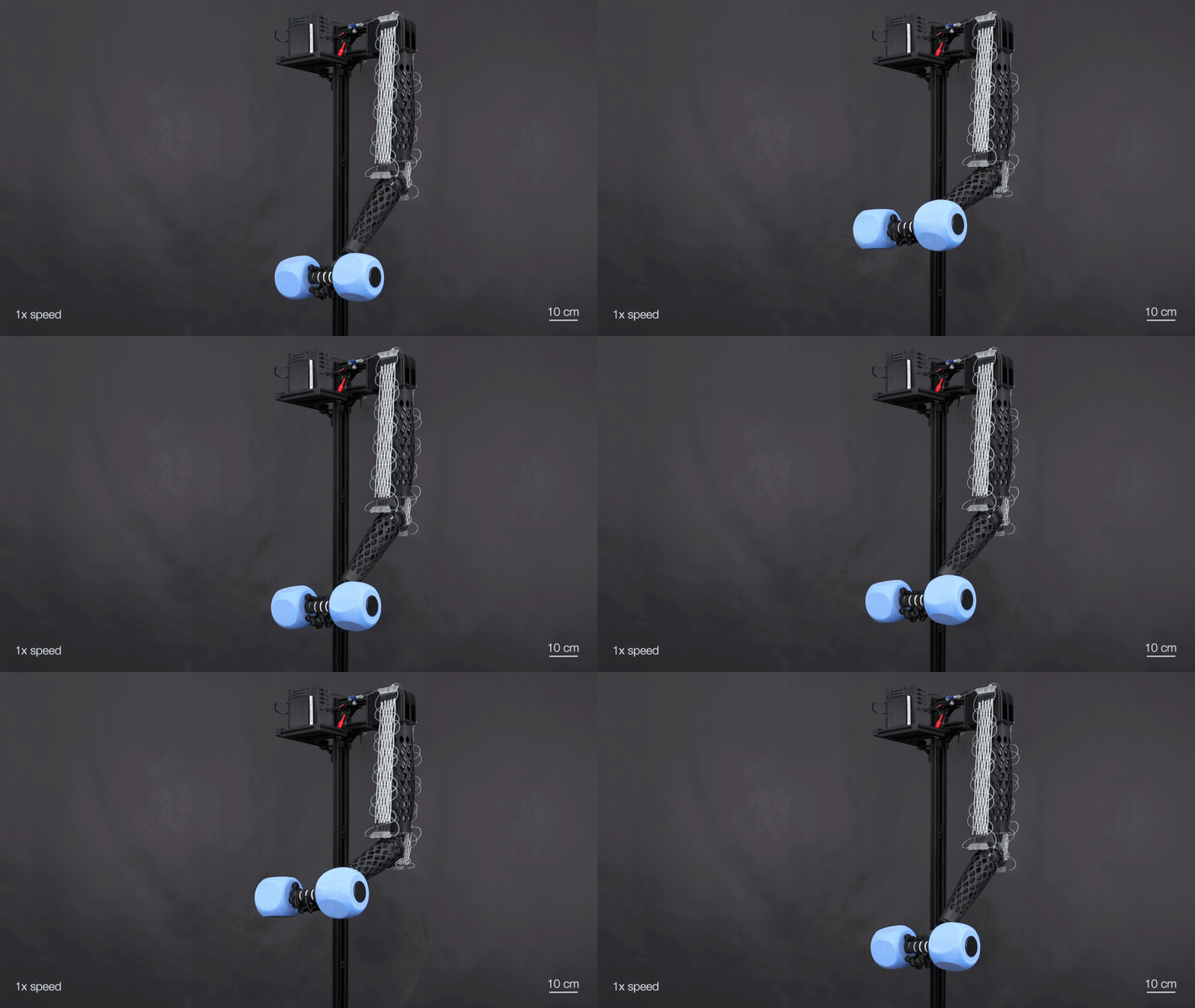
Researchers at the MIT Media Lab and Politecnico di Bari have made significant strides in the field of robotics with the development of a new type of electrically driven artificial muscle fiber. This innovative technology, detailed in a recent publication in Science Robotics, offers a more natural muscle-like contraction compared to traditional robotic systems. The new muscle fibers operate without the need for bulky motors, external pumps, or noisy machinery, presenting a more compact and efficient solution for robotic applications, prosthetics, and wearable assistive devices.
The newly developed electrofluidic fiber muscles combine fluid-driven artificial muscles with integrated miniature pumps, allowing them to function within a closed and compact design. This advancement addresses a critical challenge in robotics: the need for actuators that are not only strong and quiet but also compact and compatible with human anatomy. The research is spearheaded by Ozgun Kilic Afsar, a PhD candidate at the MIT Media Lab, along with Vito Cacucciolo, a professor at Politecnico di Bari, and four co-authors.
The Mechanics of Electrofluidic Fiber Muscles
The electrofluidic fiber muscles represent a novel class of artificial muscle fibers designed for use in robots and wearable technology. These fibers leverage two key technologies: the thin McKibben actuator, a type of fluid-driven artificial muscle, and a miniaturized solid-state pump that operates on electrohydrodynamic (EHD) principles. This pump generates pressure within a sealed fluid compartment without requiring moving parts or an external fluid source.
Historically, fluid-driven soft actuators have relied on cumbersome hydraulic systems, which can be noisy and difficult to integrate into mobile or lightweight designs. This reliance has created significant limitations in the practical application of fluidic actuators in real-world scenarios. The breakthrough achieved by Afsar and her team lies in the integration of EHD-based pumps, which are small, lightweight, and can be easily manufactured at scale. By embedding these pumps into a closed fluidic circuit with the McKibben actuators, the researchers have eliminated the need for external reservoirs, which has been a significant barrier to the use of EHD pumps in robotic systems.
The design of these muscle fibers is further enhanced by employing antagonistic configurations, where one muscle contracts while another elongates, mimicking the natural movements of biological muscles. This configuration not only reflects the organization of biological muscles but also facilitates the storage of fluid within the muscle design, thereby enhancing functionality.
Overcoming Technical Challenges
A critical aspect of the research involved managing internal pressures within the muscle fibers. The researchers discovered that the fibers must be pre-pressurized to function effectively, as insufficient pressure could lead to cavitation, a phenomenon where vapor bubbles form and disrupt the fluid flow. To counter this, the team applied an initial bias pressure to maintain the fluid’s vapor pressure, allowing for optimal performance. This bias pressure can be adjusted based on the specific application, enabling a balance between maximum contraction and response speed.
The implications of this research extend beyond just the development of new muscle fibers. Traditional robotic systems predominantly rely on electric servo motors, which generate rotational motion that must be converted into linear movement. In contrast, the electrofluidic fibers contract and extend linearly, allowing for a more natural integration into robotic designs. This fundamental difference in operation opens up new possibilities for the design and functionality of robotic limbs and exoskeletons.
Why it matters
The development of electrofluidic fiber muscles represents a significant advancement in soft robotics, particularly in terms of portability and power density. As Herbert Shea, a professor at Ecole Polytechnique Federale de Lausanne, notes, the absence of moving parts in the pump results in silent operation, which is particularly advantageous for prosthetic devices and wearable technology. This silent functionality could lead to more discreet and user-friendly assistive devices, enhancing the quality of life for individuals who rely on them.
Furthermore, the principles established in this research could be applied broadly across various fluid-driven robotic systems, paving the way for innovations in fields ranging from rehabilitation to industrial automation. By addressing long-standing challenges in actuator design, this work not only enhances the performance of current technologies but also sets the stage for future advancements in robotics and human-machine interaction.
In conclusion, the electrofluidic fiber muscles developed by the MIT Media Lab and Politecnico di Bari mark a pivotal moment in the evolution of artificial muscle technology. By combining innovative design with practical applications, this research has the potential to transform the landscape of robotics, making machines more efficient, adaptable, and human-friendly.
Frequently asked questions
- What are electrofluidic fiber muscles?
- Electrofluidic fiber muscles are a new type of artificial muscle fibers that contract similarly to natural muscles, using integrated miniaturized pumps to generate motion without bulky motors or external pumps.
- How do these muscles improve robotic applications?
- These muscles are compact, lightweight, and operate silently, making them easier to integrate into robots, prosthetics, and wearable devices, while also mimicking the natural movement of biological muscles.
- What challenges do electrofluidic fiber muscles address?
- They address the limitations of traditional fluid-driven actuators, such as reliance on external hydraulic systems, by incorporating miniaturized pumps that allow for a closed and efficient design.
Related stories
AI & art news in your inbox, daily
The day's top stories, summarized. Free, no spam, unsubscribe anytime.